Part 1 — The Man at the Back Table
I have bagged groceries at the same store for nine years. I am seventy-three years old. I like the work. It gets me out of the house, and the young cashiers make me laugh.
My grandson Ethan is the only family I have left. His mother — my daughter — passed when he was nineteen. I raised what was left of him after that. Drove him to community college in a truck with no heater. Kept a compass on the dashboard, an old brass one, scratched to hell, because a man once told me it would always bring me home. It did. It brought me back from places I don’t talk about.
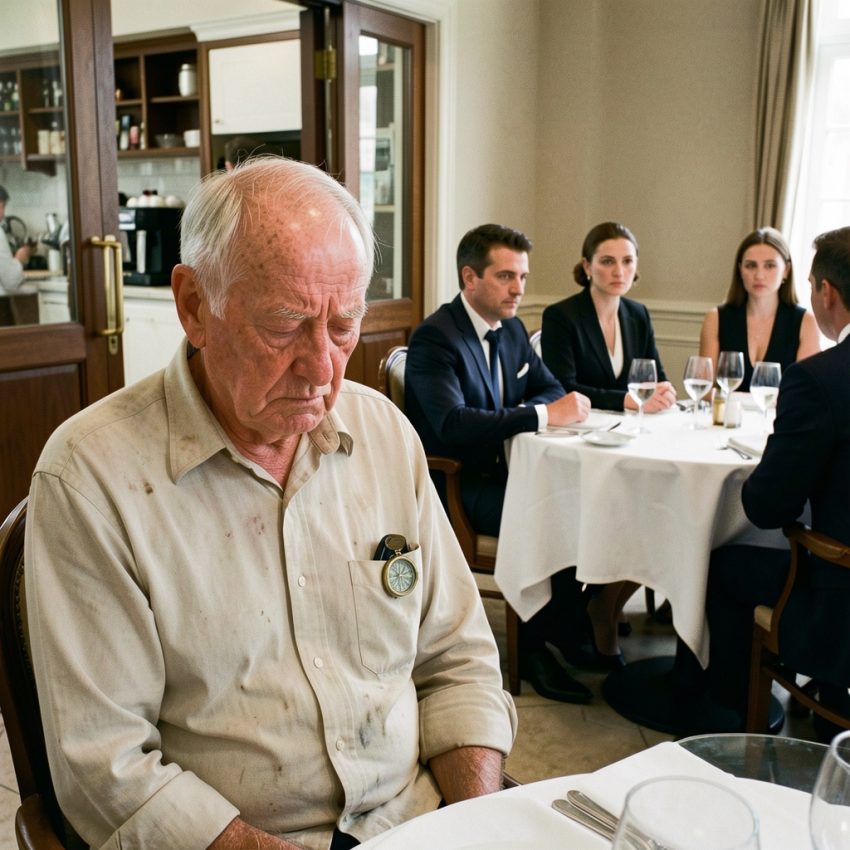
So when Ethan called and said he was getting engaged, and would I please come to the dinner, I ironed my one good shirt and I polished my one pair of shoes and I put that compass in my breast pocket, the way I always do when I need to remember who I am.
The restaurant had valet parking. I don’t valet. I parked four blocks away and walked.

Her name was Sloane. Ethan’s fiancé. Her family owned something — construction, real estate, the kind of money that talks quietly and expects everyone to lean in.
She shook my hand with two fingers.
“You must be the grandfather,” she said. “Ethan mentioned you. You work at the… grocery store, was it?”
“Nine years,” I said. “I bag groceries.”
She smiled the way people smile when they’ve already decided something about you.
“How sweet. Keeping busy.”
They sat me at the back table. Not with Ethan. Not with the parents. At a small table near the kitchen door, next to a boy of maybe eight — Sloane’s cousin — who kept kicking the table leg.
I didn’t say anything. A man who has eaten worse meals in worse places does not complain about a chair.
Halfway through dinner, Sloane’s father stood to make a toast. He talked about legacy. About the kind of people this family surrounds itself with. About “building something that lasts.”
Then he looked toward my table, and he chuckled.
“And of course we welcome Ethan’s… people. Everyone starts somewhere.”
The table laughed. Politely. The way you laugh at something you’re supposed to.
Ethan stared at his plate. He didn’t look at me. That hurt worse than the chair.
I put my hand over my breast pocket, over the compass, and I breathed.
What none of them knew was that I had almost not come at all. And what none of them knew was who else had been invited to that room — a man I hadn’t seen in fifty-one years.
Part 2 — The Man in the Doorway
Let me tell you about the compass.
In 1971 I was twenty-two and stupid and a long way from home. My unit walked into something we were not supposed to walk into. I won’t describe it. I made a promise a long time ago not to.
What I’ll say is this: there was a lieutenant, younger than me, who froze. And there was a moment where freezing meant dying — his and four others. I grabbed the back of his collar and I dragged him, and I got the five of them out through a treeline using a brass compass a dead man had pressed into my hand an hour before.
The lieutenant’s name was Raymond Okafor.
I never saw him again. I heard he made it home. I heard he made a career of it. I heard a lot of things, over the years, the way you hear things.
I never told anyone what happened out there. Not my late wife. Not my daughter. Not Ethan. It isn’t a story you tell to be admired. It’s a story you carry so that other men get to grow old.

Back at the dinner, dessert was coming out when the restaurant’s front door opened.
A man walked in. Tall. Silver hair. Straight-backed in the way that only two kinds of men stand — men who have never been broken, and men who have been broken and rebuilt themselves on purpose.
He was in a dark suit, but you could see the uniform underneath it, if you knew how to look. And on his arm was a younger officer carrying a folded flag case.
The maître d’ hurried over. Sloane’s father stood, all smiles, assuming the important man had come for him.
“General Okafor, what an honor, we weren’t expecting—”
The general wasn’t listening. He was scanning the room. Table by table. Face by face.
And then he stopped.
He was looking at the back table. At the man next to the eight-year-old. At me.
His voice, when it came, was very quiet, and the whole room went quiet to hear it.
“Sergeant,” he said. “Why in God’s name are you sitting at the back?”
Part 3 — What a Man Is Worth
I stood up. Slowly. My knees don’t do anything fast anymore.
“Lieutenant,” I said. Old habit. “You got old.”
“General now,” he said. “Thanks to you. I’ve been looking for you for eleven years.”
You could have heard a fork drop. Nobody moved.
Raymond Okafor walked across that dining room, past Sloane’s father with his frozen smile, past the parents, past Ethan, and he stopped in front of a grocery bagger at a back table, and he saluted me.
Then he turned to the room.
“This man,” he said, “carried five soldiers out of a place none of us should have survived. He was twenty-two. He never accepted a medal for it because he said medals belonged to the man who didn’t make it. I have spent my life trying to become someone worthy of what he did in ten minutes.”
He looked at Sloane’s father.
“You spoke about legacy tonight. About surrounding yourself with the right people.” He nodded toward me. “That is the right person. You sat him by the kitchen.”
Sloane’s face had gone the color of the tablecloth. Her father opened his mouth and found nothing in it.
And Ethan — my Ethan — pushed his chair back so hard it fell, and he crossed the room, and he put his arms around me in front of all of them, and he said into my shoulder, so only I could hear:
“I’m sorry. I let them sit you back here. I’m so sorry, Grandpa.”
I held the back of his collar. The way I once held another young man’s collar. And I said what I have always believed.
“You came and got me now. That’s what counts.”

The general stayed for an hour. He’d tracked me down through the store, of all things — a young cashier had posted a photo online months ago, “the sweetest man bags our groceries,” and one of the general’s aides had recognized the compass in my shirt pocket in the corner of the frame.
Fifty-one years, and a brass compass brought him home to me.
There was no inheritance that night. No check. Nobody handed me a fortune. I went back to bagging groceries that Monday, same as always, and I liked it same as always.
But Ethan calls me every Sunday now. And Sloane — to her credit — came to the store two weeks later, alone, and stood at my register and said she was ashamed of herself, and asked if we could start over.
I told her the truth. I told her that a man isn’t worth what his shirt costs or where he’s told to sit. A man is worth who he becomes when nobody’s watching, and who he pulls out of the fire when it counts.
Then I bagged her groceries. Bread on top. The way I do for everybody.
I keep the compass on my dashboard still. It’s brought a lot of people home now.
Including me.