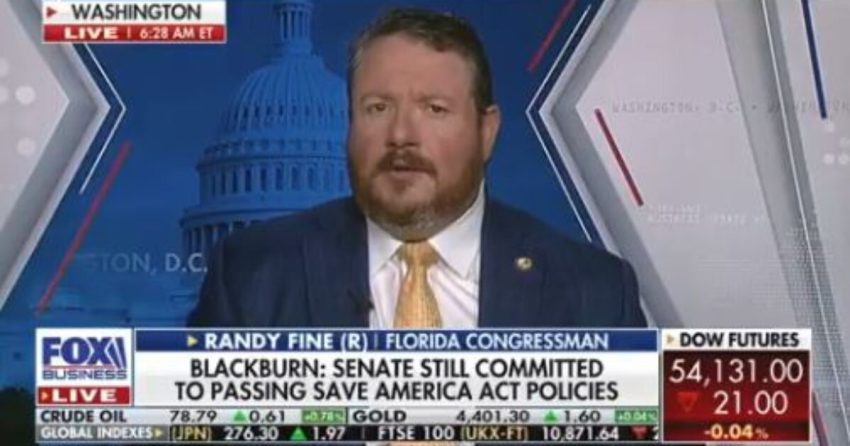
Rep. Randy Fine (R-FL) appeared on Fox Business on Monday morning to make the case for the SAVE America Act, an election-security measure that includes a voter identification requirement, and to argue that Senate Republicans already have more than one procedural route available to get it to a final vote.
The congressman’s central message was not about writing new legislation. It was about tactics. In his telling, the bill’s supporters do not need to wait for a change of heart in the Senate — they need to choose one of two existing avenues and follow through.
“There’s two paths to get the job done,” Fine said. “The point is they just need to pick one and do whatever it takes to get it done.”
## Two Procedural Routes
The first option Fine described is attaching the measure to the reconciliation bill the House has already sent to the Senate. Reconciliation is a budget process that allows certain legislation to pass the Senate with a simple majority rather than the 60 votes typically needed to overcome a filibuster.
“We put SAVE America in the reconciliation bill that we sent to the Senate,” Fine said. “That would only take 50 votes. So there’s one way to get it done.”
The second route he outlined draws on what he described as the bill’s recent performance in the House. According to Fine, House lawmakers paired the SAVE America Act with a separate proposal barring members of Congress from insider trading — a pairing he said produced a broader coalition than the election measure had previously drawn on its own.
“We attached the SAVE America Act to something even more popular, the idea that members of Congress can’t insider trade,” Fine said. “And when we did that, we not only got every Republican vote, we got a dozen Democratic votes in the House. It was the first time we’ve ever seen a Democrat vote for SAVE America.”
He suggested the Senate could attempt the same combination. “So maybe that’s what they try in the Senate,” he said. “Do ‘You Can’t Insider Trade plus SAVE America.'”
The two approaches are different in kind. The reconciliation path is a math problem — it lowers the vote threshold and relies on holding a narrow majority together. The second is a coalition problem — it bets that pairing the election provisions with an ethics measure that has cross-party appeal will pull in votes the bill would not otherwise attract.
## The Polling Argument
Fine and the segment framed the voter ID provision as one of the less contested pieces of the package. The figures cited in the discussion put support for requiring a photo ID to vote at 95 percent among Republicans and 71 percent among Democrats.
Those numbers are the core of the argument supporters are making: that the underlying policy is not a narrow partisan ask, and that a requirement backed by strong majorities in both parties should not be difficult to move.
Critics of voter ID requirements have long argued that such rules can create obstacles for eligible voters who lack current identification, particularly older, rural, and lower-income Americans. That side of the debate was not addressed in Monday’s segment, which focused on the legislative mechanics rather than the policy dispute.
## Where the Resistance Is
The commentary accompanying the interview placed the obstacle in the Senate rather than the House. It characterized Democratic officeholders as opposed to a photo ID requirement, and it also singled out Majority Leader John Thune, questioning his position on the measure. Those characterizations were the framing of the segment and its accompanying commentary. Thune’s own reasoning was not presented in the interview, and no statement from his office was included.
That distinction matters for readers trying to gauge where the bill actually stands. What the segment establishes is that Fine believes the votes and the vehicles exist. What it does not establish is whether Senate leadership intends to use either one, or how the chamber’s parliamentarian would treat election provisions inserted into a budget reconciliation package — a recurring constraint on what can and cannot ride along in that process.
A social media post from journalist Eric Daugherty, published August 10, 2026, summarized the interview by noting that a reconciliation route would put Vice President JD Vance in position to break a tie in a 50-50 Senate. That is a description of how reconciliation math works rather than an announcement of a scheduled vote. No vote has been noticed, and no commitment from Senate leadership was reported in the segment.
## What Happens Next
For now, the SAVE America Act sits where a great many House-passed measures sit: waiting on the Senate calendar. Supporters like Fine are pressing leadership to attach it to a moving vehicle rather than let it wait for standalone floor time that may never be scheduled.
Readers who want to track the bill can follow the Senate’s handling of the House-passed reconciliation package, which is the more immediate of the two paths Fine described. If the election provisions are included in that package, the threshold drops to a simple majority. If they are not, the pairing strategy Fine described would require Senate sponsors to construct the same coalition that produced the House vote — and to hold it together in a chamber where the rules give individual members considerably more leverage to slow things down.